
De Baca Projected Release Dates
A projected date is a calculation based on the sentence, known credits, and current status. An actual release date is the timestamp of a completed movement out of a custodian’s control. The court sentence date, NMCD arrival date, parole eligibility date, prison release date, supervision start, and final discharge can all be different. The label matters as much as the number.
NMCD Victim Services policy and the certified case-summary policy use several terms. A projected release date reflects a sentence calculation. A certified release date is used in operational release processing. An anticipated date of release may appear in certain parole work. Actual release is the completed prison movement. Discharge ends the relevant NMCD sentence or supervision duty.
- Projected release date
- A current calculation that may change before the event.
- Actual release
- The completed physical departure from the named custodian.
- Parole eligibility
- A point when parole rules may apply, not a promise of release.
- Discharge
- The formal end of the relevant sentence or supervision obligation.
- Detainer
- A request or hold that may lead to another custodian rather than community release.
For a De Baca County pretrial detainee, a fixed sentence calculation may not exist. A bond order or dismissal can authorize release, but jail processing and other holds still control actual departure. The court docket explains legal action. The detention movement record shows whether and when the person left.
Find De Baca Release Dates
Choose the channel by custody type. The De Baca County Detention Center houses local pretrial and sentenced people, including some contract detainees from another county. NMCD covers state-sentenced prisoners and community supervision, not ordinary county-jail custody. Federal BOP custody has a separate locator. Applying a state prison date rule to a local jail stay creates a false answer.
- Identify the current custodian. Call the De Baca County Detention Center at 575-355-7870 for local custody, or use the state or federal locator when the sentence belongs there.
- Obtain the judgment and sentence. Confirm each count, offense date, sentence length, and whether terms run at the same time or one after another.
- Confirm presentence confinement credit and the date the custodian uses as the computation start.
- Search the relevant record. For NMCD, use the offender search and read only the date labels the result actually displays.
- Ask the institution or jail for the current calculation record when the public result omits the field or when the date is movement-sensitive.
- Confirm actual release with the departing facility and follow any receiving agency or supervision record.
The official NMCD offender search accepts a first name, last name, or NMCD number. The live application also permits age range and status choices. Use Include Inactive when the person may have completed state custody or supervision. NMCD asks users to allow 24 hours for Adult Prisons updates, while Probation and Parole data is described as real time.
The official NMCD live search shows how the identity and status controls are presented for a state release-date lookup.
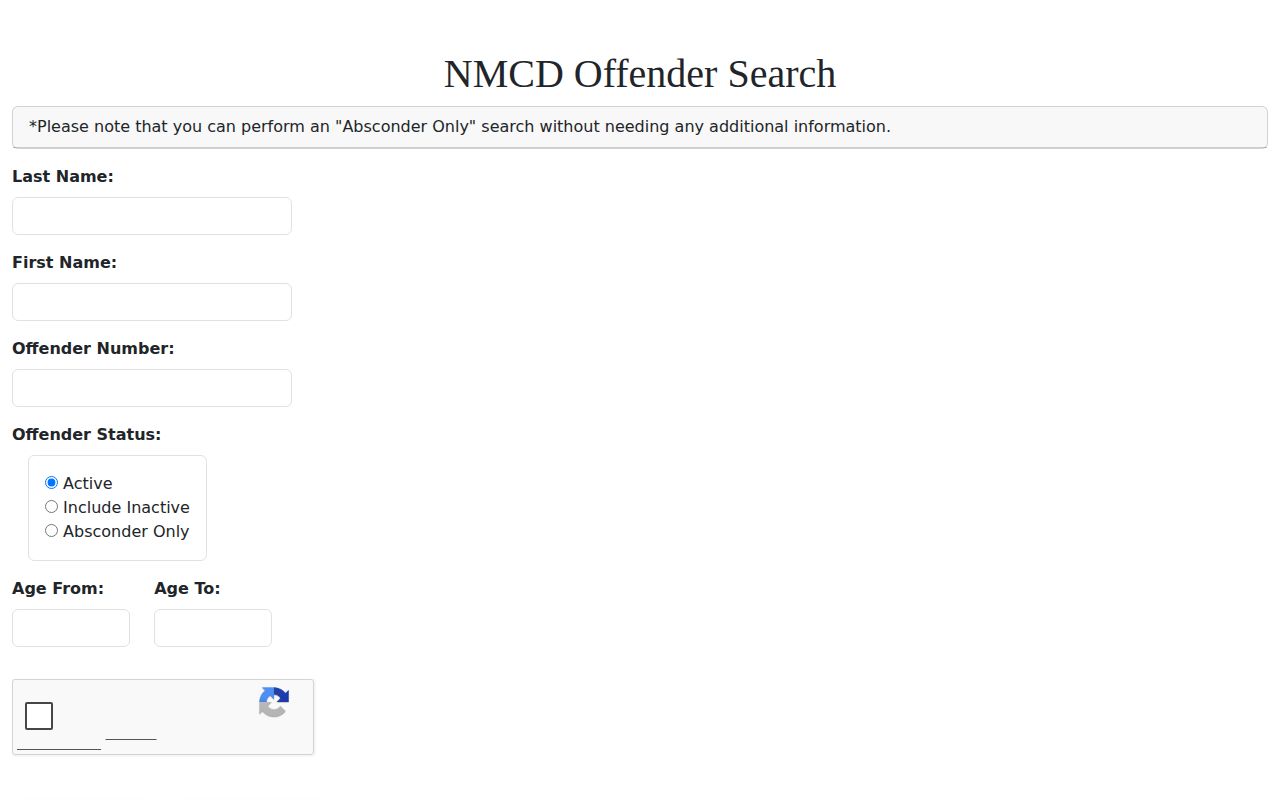
The search is a starting point. A result must be matched by identifier, and a missing field should lead to the institution or a focused records request rather than a guessed date.
Note: NMCD central records states that it does not provide live release updates, so use the current institution for movement-sensitive confirmation.
De Baca County Date Channels
A local De Baca County sentence and an NMCD prison sentence require different calculations. For a county sentence, ask the detention center for the sentence computation or release calculation and the authority for each credit. Section 33-2-34 governs eligible prisoners in Corrections Department-designated facilities and should not be copied onto a county jail stay without proof that it applies.
The De Baca District Court handles felony matters, while Magistrate Court covers misdemeanor and preliminary matters and Fort Sumner Municipal Court has limited municipal cases. New Mexico Case Lookup can show a judgment, sentence, bond order, dismissal, or later docket event. Its online data is a summary, not the official record. Obtain the filed judgment when exact language controls the date.
For state custody, the offender record and current institution form the verification pair. NMCD’s public landing page does not promise a universally displayed projected-release field, and the research did not preserve a lawful sample establishing one exact label. If a live result shows a date, copy its precise label and as-of information. If it does not, request the certified case summary or calculation record.
| Custody or status | Best date source | Key limit |
|---|---|---|
| De Baca pretrial detention | Court order plus jail movement record | No fixed sentence date may exist |
| De Baca county sentence | Jail sentence computation and judgment | Do not assume NMCD credit rates |
| NMCD prison sentence | Offender result, institution, and NMCD calculation record | Projected date can move |
| NMCD parole or probation | P&P office and discharge record | Prison release is not discharge |
| Federal prison sentence | BOP locator and institution | A future BOP date is projected |
The complete De Baca County custody-source search is available on the released inmates home page. It helps determine whether the date belongs to a local departure, state intake, federal record, or post-release supervision.
De Baca Earned Deduction Rules
Section 33-2-34 NMSA 1978 governs eligibility for earned meritorious deductions in Corrections Department-designated facilities. Qualifying participation in recommended or approved programs is part of the statutory framework. The maximum deduction varies by offense category and other controlling facts, so the same rate cannot be applied to every NMCD prisoner.
For a serious violent offense, the maximum is four days per month of time served. This cap is often described as an 85 percent rule because it produces service of about 85 percent, but it is not an independent promise that every person will leave at the same percentage point. The precise statute, offense date, judgment, classification, and credits actually awarded control. For a nonviolent offense, the statute allows a different maximum of up to thirty days per month. Other subsections address parole revocation, segregation, and some life-sentence cases.
Some offenses are listed as serious violent offenses. Others may depend on findings required by law. Amendments also matter. The 2025 treatment of vehicular homicide and great bodily harm reinforces why the offense date and controlling judgment must be reviewed. A charge label on a search result is not enough to compute an individual date.
NMCD inmate-record policy identifies date records that may include Good Time Figuring Sheets, quarterly good-time material, award recommendations, forfeiture or restoration records, lump-sum recommendations, and Offender Management System figuring sheets. Ask for the current calculation method and awards actually posted. Do not assume that the statutory maximum was earned.
Why De Baca Dates Change
A projected date changes when a fact in the sentence calculation or release path changes. Some changes affect the number of days. Others do not change the sentence calculation but prevent the person from returning to the community on that date. Keeping those two effects separate prevents a detainer or transfer from being mislabeled as extra sentence time.
| Factor | Possible effect | Record to check |
|---|---|---|
| Credits awarded | May move the projection earlier within the governing rules | Current figuring sheet or calculation record |
| Forfeiture or restoration | May move the date later or earlier | Disciplinary and restoration record |
| Sentence amendment | Can change the controlling term or credit | Filed court order and new calculation |
| Consecutive or concurrent terms | Changes how separate counts combine | Judgment and sentence computation |
| Detainer or new hold | May cause transfer instead of community release | Movement record and receiving agency |
| Parole plan or decision | May affect when community placement can occur | Institution, P&P, or Parole Board record |
Parole eligibility is not a release promise. Many determinate post-1979 sentences proceed to parole after the prison portion, but an adequate parole plan may still be required. Older indeterminate terms and specified life or first-degree-murder cases can involve discretionary Board action. Section 31-21-10 supplies general parole terms and life-sentence rules, while offenses committed under age 18 have separate Section 31-21-10.2 treatment.
Note: A new hold can leave the calculated prison date intact while changing the destination from community release to another custodian.
Request De Baca Date Records
When the date is absent or unclear, request the existing calculation rather than asking an agency to create a forecast. For a De Baca County jail sentence, ask for the judgment relied on, jail credit, sentence computation, projected or scheduled exit date if maintained, and the record showing actual release or transfer. State the full name, booking number, and a narrow date range.
For an NMCD record, request nonexempt documents sufficient to show admission, movements, actual release and destination, parole or probation start and completion, and discharge. Also name the certified case summary or calculation record showing the projected release date and calculation method. NMCD uses NextRequest as its regularly monitored online submission route.
Under New Mexico IPRA, a written request should be answered through the statutory process. If inspection is not prompt within three business days, the custodian provides written timing. Production or denial is normally due within 15 calendar days, subject to the law’s broad or burdensome request provision. Ask for electronic delivery and for the legal basis of any withheld portion.
A focused date request is more useful than asking for the full institutional file, which can contain medical, social, risk, and security material subject to protection. The narrow record can still show why a projected date changed and how actual release differed from the earlier calculation.
Confirm De Baca Actual Release
Near the projected date, contact the institution or detention center. Ask whether the date remains current, whether another hold exists, and whether the expected event is community release, parole, court movement, or transfer. NMCD central records is not the source for imminent movement updates. The current institution or assigned P&P office is closer to that status.
New Mexico VINE can add a supported release alert, but it does not certify final disposition. During the NMCD upgrade reported July 29, 2026, some searches, registrations, and notifications were unavailable while alerts for existing registrants continued. Current VINE instructions, including the PIN and transfer re-registration rules, are covered on the De Baca County VINE check.
After an alert, obtain the movement record. A court order can precede actual jail departure. A county record marked released to NMCD means transfer, not freedom from incarceration. A prison release to parole begins supervised status and is not discharge. Record the source and timestamp for each date, then use the receiving system to finish the custody chain.
The strongest final answer names the milestone: “projected release,” “actual release from the De Baca County Detention Center,” “received by NMCD,” “released from prison to parole,” or “discharged from NMCD.” That wording is more accurate than presenting one unlabeled date as the end of every legal and custody status.