
De Baca Detention Center Releases
The De Baca County Detention Center is the county's only verified physical custodial facility. It holds people awaiting court action and people serving county-jail time. A local person may leave on bond, after dismissal, through time served, or at the end of a sentence. A felony judgment can instead send the person to the New Mexico Corrections Department. Another warrant, writ, or hold may transfer custody to a county or federal authority.
Read the movement destination before choosing the next search. Release to the community is different from release to transport. If the record names NMCD, search the state system after intake. If it names an originating county, ask that county for the next event. A federal or immigration handoff must be followed in the relevant federal channel. The word “released” on one facility's record marks exit from that facility, not necessarily the end of confinement.
| De Baca exit | Likely next record | What to confirm |
|---|---|---|
| Bond or court release | Detention movement and court docket | Actual exit time and any other hold |
| Time served or sentence complete | Local release record | Whether another authority took custody |
| NMCD commitment | NMCD offender search | State intake and current institution |
| Originating-county return | Both counties' movement records | Receiving agency and later status |
| Federal or ICE handoff | BOP, federal court, or ICE ODLS | Which federal custodian accepted the person |
Confirm De Baca Detention Releases
No official De Baca County jail roster or recent-release feed was verified as of July 29, 2026. Confirmation starts with the facility, not a county-named unofficial search page. Staff may limit what they disclose by telephone, but the call can identify whether the person is still physically housed and which office maintains the movement record.
- Call 575-355-7870 with the full booked name and any booking or case number.
- Ask whether the person is physically housed. If not, ask whether the departure was release or transfer.
- Request the record showing actual exit date and time, release reason, destination, and receiving agency.
- Search the relevant district, magistrate, or municipal court for the legal event behind the movement.
- Follow the named receiver into NMCD, another county, BOP, or ICE rather than assuming community release.
For the full custody-type decision tree, the De Baca County released inmate search explains the local, court, state, notification, and federal paths.
De Baca Detention Release Records
Ask for existing records, not a conclusion. A precise request identifies the person and booking window, then names the booking sheet, custody-movement log, and the record showing the actual release date and time. Include the release code, type, or reason; destination or receiving agency; and booking photo only when that image is part of the request. If no “release certificate” exists, the exit transaction or movement history may hold the same facts.
New Mexico's Inspection of Public Records Act, Sections 14-2-1 through 14-2-12 NMSA 1978, governs the request subject to lawful exceptions. Ask for electronic delivery and for the legal basis behind any withheld part. Written requests receive timing protections: if inspection is not prompt within three business days, the custodian should give written timing, and a response or denial normally follows within fifteen calendar days unless the request is excessively broad or burdensome.
The statewide records schedule at 1.21.2.902 NMAC permits destruction of a jail inmate file five years after closure. That period is not an online publication promise. It does show why an absent live result is different from a retained agency file. Older court dockets may outlast the county jail file, so use the court as a second source.
Note: Request release type and destination together because a timestamp alone cannot separate community release from interagency transport.
De Baca Release Records Contact
The detention center and sheriff have related but distinct roles. Send a custody or movement request to the records custodian most likely to hold it, and ask that the request be routed if a different county office maintains the record. The sheriff may hold arrest and transport material, but it is not a state-prison locator.
De Baca County Detention Center248 East Avenue C
Fort Sumner, NM 88119
Mailing: PO Box 240
Phone: 575-355-7870
Fax: 575-355-7875
The published sheriff directory lists the Sheriff's Office at 248 Avenue C, PO Box 347, Fort Sumner, with telephone 575-355-7433 and fax 575-355-3276. Its stated hours are Monday through Thursday, 8:00 a.m. to 4:00 p.m. No separate detention records hours were established, so call before relying on an in-person visit.
Inside De Baca Release Facility
The official construction profile describes an 8,800-square-foot detention project with separate male and female pods, a kitchen, laundry, and employee areas. The profile does not state an opening date. It should not be used to manufacture one.

The facility design image identifies the county detention project, while the release record remains the source for a named person's exit. A building profile cannot establish custody, release, or destination.
The center is under De Baca County Commission authority. A historical statewide detention overview supplies past context only, not a current capacity or release count. The population can include local pretrial detainees, local sentenced people, and adults housed by agreement for another county. Those groups may leave by different routes.
Quay Release Transfers From De Baca
The most important local distinction comes from an intergovernmental detention agreement. De Baca has held Quay County adults, while Quay remained responsible for transport to and from Fort Sumner. Quay also supplied booking and medical-clearance documents. Minimum and medium custody placements were accepted under the agreement, maximum custody required case-by-case discussion, and the De Baca administrator could refuse a placement.
The Quay County Commission agreement is direct government evidence of this split responsibility. It proves that departure from the De Baca building can be a return to Quay officers, not release to the community. Ask De Baca for the destination, then ask the originating county for what happened after pickup.
A contract detainee's records may therefore be divided. De Baca can document the physical stay and exit. Quay may hold the originating booking packet, transport authorization, case connection, and later custody event. A complete answer can require both sets.
De Baca Contract Release Limits
The Quay agreement also bars its contract detainees from road crew, work release, or porter roles without a court order or prior Quay permission. This is a specific control on adults housed for Quay. It is not evidence of a work-release program open to all De Baca detainees.
If a record suggests a work-related movement, ask which court order or originating-county approval governed it. Then obtain the movement entry showing whether custody continued. A temporary authorized movement must not be described as final release. The same care applies to court trips and medical transport.
NMCD Releases After De Baca
A person sentenced to state prison moves into a separate system. The NMCD offender search expressly excludes county and city detention and covers only people in NMCD prisons or under NMCD probation or parole. After a De Baca transfer, intake may take time to post. Adult Prisons information updates nightly, and NMCD asks users to allow twenty-four hours.
Search by NMCD number when known, or by first and last name while comparing identity and offense fields. If state custody and supervision may have ended, select Include Inactive in the live search. An inactive result is a lead to an ended NMCD status, not a release explanation. A person released from prison to parole remains under state supervision and is not fully discharged.
A county-only detainee may never appear in NMCD. For that person, the De Baca movement record and court case are controlling. Conversely, once the state accepts custody, the state institution and NMCD record are better sources for the later prison release than the county jail.
VINE Checks After De Baca Release
New Mexico VINE supplies participating-agency custody information and automated event alerts. It is not a release certificate. A VINE notice reports what the feeding agency sent, and a transfer may require a new registration with the receiving agency. As checked July 29, 2026, New Mexico's official page reported an NMCD component upgrade affecting NMCD searches, new registrations, and notifications, while existing registrants' release notifications continued.
The VINELink interface begins with state and person selection. Compare all identifiers before choosing a result, since a similar name is not enough.
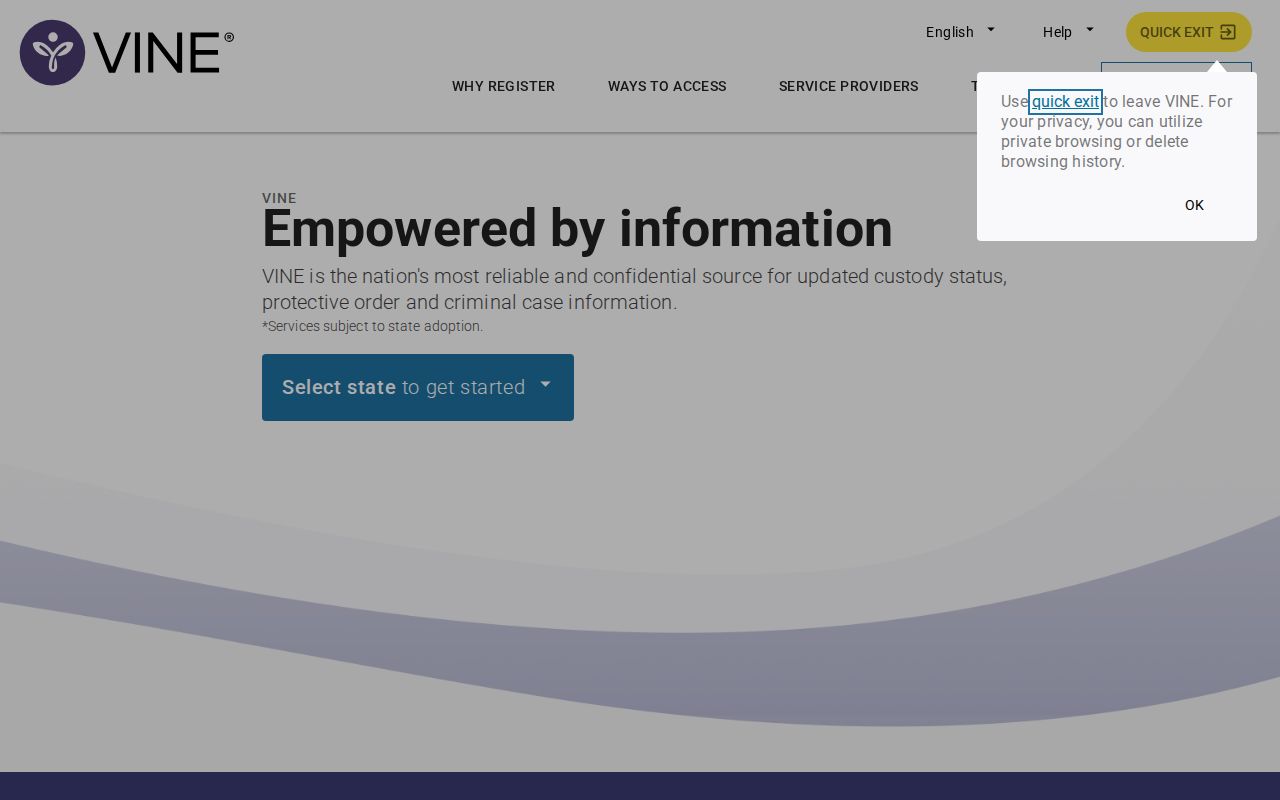
The interface can help track a supported status or set an alert, but the De Baca movement record remains essential when the issue is whether an event was community release or transport.
ICE Holds and De Baca Releases
No ICE facility or verified ICE detention contract was found in De Baca County. Immigration custody is a conditional path, not a routine local assumption. An ICE detainer can request notice and short continued custody so federal officers may take the person after the ordinary local release point. If that handoff occurs, departure from De Baca is a transfer.
The ICE Online Detainee Locator can show current detention and a recently ended ICE status for roughly sixty days. Search by full name plus A-number, or by date of birth and country of origin. Exact-match rules, lag, exclusions, and the short window can cause no result. Released from ICE also does not state the person's destination.
Federal criminal custody follows another route. USMS offers no public prisoner locator, so pretrial context comes from the federal court docket. After a federal prison commitment, BOP's locator may show a release date and “Released” or no BOP location. That proves exit from BOP, not the end of every form of custody or supervision.
Note: Use a federal locator only when a local record or case fact supports that jurisdiction; do not search it as a generic fallback.